Tampilkan postingan dengan label Technology. Tampilkan semua postingan

Rabu, 29 Februari 2012

Interview: Steve de Brun, Co-Founder of StockTouch


Today, I’m proud to publish an interview with a co-founder of a visually dynamic finance application called StockTouch.  Priced at $4.99, StockTouch uses color heatmaps to illustrate fluctuations in price movements.  Unlike the Wall St. Journal listings of NASDAQ and the S&P 500, StockTouch organizes stocks via color-coding into nine sectors--consumer goods, services, healthcare, energy, technology, financial, industrial goods, materials, and utilities.  If you want to read recent news articles or stock charts for a particular a company, you simply press your finger on the ticker symbol.  The app is intuitive, informative, loads quickly over wi-fi and 3G connections.  All things considered, the app blends finance and design fluidly.  To learn more, please visit stocktouch.com.            
1. Can you tell us about your educational and professional background?
Jennifer Johnson, our CEO, has a B.S. in Economics from Wharton and an MBA from Columbia. She is a former investment banker and finance professional who worked at UBS and Merrill Lynch, and is currently an entrepreneur and angel investor.
Steve de Brun, co-founder and VP of User Experience, has a B.A. in Visual Arts from Brown University. He has worked for early digital agency vivid studios, News Corporation, guru.com, and many other venture-funded companies.
John Morris, CTO, is a software developer and mobile game programmer, as well as co-founder of Blue Lava Wireless games, which was sold to JAMDAT, which was sold to Electronic Arts.
2. For our readers, can you describe StockTouch?  Specifically, what differentiates StockTouch from other finance apps in the market?
StockTouch is a dynamic, zoomable heat map of the stock market that gives you a birds-eye view of 900 companies organized by sector, and allows you to zoom in to view individual sectors and specific stocks. It enables you to touch and manipulate the data, and we believe this creates a more powerful experience of the information landscape.
3. What advice do you have for college students interested in starting their own business?
Make sure you develop your critical thinking and problem solving skills, and your social skills. Don't worry too much about specific academic qualifications, but if you're going to be an artist or coder obviously dig in and learn as much as possible. Build pet projects, websites and apps for friends, families and small businesses. Try to get involved with startups as a summer intern - spend time on Crunchbase.com, identify recently funded companies in your area, and approach them.
4. What market(s) are you targeting with StockTouch?
StockTouch is used by retail investors, but we are also finding that finance professionals are using the app as well. StockTouch is focused on equities traded on U.S. exchanges currently (even global companies traded on U.S. exchanges) and we plan on expanding our coverage over time.
5. Is there anything else you’d like to share about StockTouch?  
We believe that StockTouch is in its infancy, and there's a long way to go to expand the capabilities and possibilities with this app. We are entering an age where it will be expected that you can get hands on with data and interact with data visualizations in a more palpable, dynamic and fun way.

Senin, 05 Desember 2011

4.74 Degrees of Separation


 http://images.nationalgeographic.com/wpf/media-live/photos/000/011/custom/neutron-star-magnetar_1118_610x343.jpg

Try to recall a time when you were in a crowded intersection or a busy airport far from home.  It’s possible that the person sitting next to you was a friend of a friend of a friend of a friend. 

Have you ever heard the six degrees of separation?  It’s the idea that everyone is on average six steps away from any other person on Earth.  Friend of a friend statements can be used to connect any two people through six steps.  The original six degrees of separation finding, published in 1967 by psychologist Stanley Milgram, was determined from a sample size of 296 volunteers who were asked to send postcards to a specific person in a Boston suburb.

New research from scientists at Facebook and the University of Milan has found that the average number of acquaintances separating any two individuals in the world is now 4.74.  This new finding used a slightly larger cohort: 721 million Facebook users (more than one-tenth of the world’s population).  The researchers used a set of rules to calculate the average distance between two people by computing a vast number of sample paths among Facebook users.  

The power of social networks has undeniably grown in the past decade.  This recent experiment reveals that the average number of links from one randomly selected person to another is 4.74.  In the United States, where more than half of people over the age of 13 are on Facebook, it was just 4.37. 

A question we must consider is the definition of a friend.  Consider you list of friends on Facebook.  How many of them do you actually count as your close friends?  The weak ties between individuals might be what is making the world so small.  In 2008, a study conducted by Microsoft used a more conservative definition of friend, and found an average chain of 6.6 people within a group of 240 million. 

Jumat, 04 November 2011

Groupon's IPO Prices at $20 Per Share

 http://www.impactlab.net/wp-content/uploads/2011/09/groupon.jpg


Groupon’s roadshow certainly had its highs and lows, but founder and CEO Andrew Mason expected skeptical audiences.  A roadshow consists of a series of meetings with potential investors and brokers conducted by a company and its underwriter prior to an initial public offering.  Normally a casual dresser, Mason got a new haircut and dressed in a suit as he attempted to persuade prospective financiers that Groupon is a sound investment choice.  At the end of Tuesday, Groupon priced its initial public offering at $20, exceeding the expected range of $16 to $18. 

Groupon is initially selling just 35 million shares, or 5 percent of total shares.  The low supply has caused an increase in the price.  In this regard, Groupon is following a trend set by other US internet firms.  LinkedIn, which went public in May, sold less than 10 percent of its total stock in its IPO. 
On November 4, Groupon will start trading on the NASDAQ stock exchange.  If the stock price increases significantly on the first day, expect Zynga and Facebook to expedite their IPOs. 

Groupon’s business model is somewhat questionable, causing uncertainty among potential investors.  The tech company prompts customers to shop as groups rather than individuals so they can earn deep discounts from local businesses.  The discounts only apply if there is a certain number of customers that sign up for a deal.  As explained on Groupon’s site, “Each day, Groupon e-mails its members one unbeatable offer on something great to do in your city.  We offer consumers great values by guaranteeing businesses a minimum number of customers.  If a certain number of people sign up, then everyone gets the Groupon offer.  If that minimum isn’t reached, then no one gets it.”

Groupon seizes economies of scale by connecting large numbers of customers with businesses.  A company captures economies of scale when it lowers the average cost per unit through increased production.  For instance, when 10,000 laptops are made, the per unit cost is cheaper than if only 1000 were manufactured because fixed costs are spread over a larger production batch.
Local businesses receive two benefits from Groupon’s offerings.  First, they receive guaranteed demand for their products and services, which lowers excess inventory and attains economies of scale.  Second, Groupon creates communication and anticipation for new products and services. 
On the positive side, Groupon has demonstrated rapid growth.  In under 2 years, it has grown from 152,203 subscribers to 83.1 million.  During that same time, revenue has grown from $3.3 million to $644.7 million.

So how does Groupon make money?  Consumers purchase a coupon through the Groupon website.  When someone purchases, say, a $40 massage, for $20, Groupon will keep $10 and pass the remaining $10 onto the business.  In this instance, the massage parlor is providing a $40 massage for $10, but it attracted a customer it might have otherwise not gained.
This business model might not be sustainable because small businesses are actually hurt when a Groupon is successful.  Potential losses increase with every Groupon customer that walks through the door.  Imagine if 10,000 people showed up wanting a $40 service, but the company only receives $10 per massage.  The massage parlor’s per unit revenue will be slashed by 75%, but its costs remain the same.      

Businesses with high fixed costs and low variable costs will benefit from using Groupon.  Health club memberships, yoga classes, sporting events, DVDs all fall under this category.  High margin businesses that can afford a 75% reduction in revenue might also be interested in Groupon.  Take for example a jewelry shop where the retail price is 500% of the actual cost.  A Groupon 75% discount (25% to Groupon, 50% to the customer) might work for this type of business. 

What do you think?  Is Groupon’s business model sustainable?  Is the $20 stock price too high?

Rabu, 19 Oktober 2011

6 Momentous Events In Social Media History


The phrase "social media history" seems like a bit of a contradiction.  However, you might be surprised to know that social media has been around for 15 years.  Although Facebook, Linkedin, and Twitter are the main players in the social media realm, other companies developed the critical concepts while Mark Zuckerberg was still in grade school.

1994: TheGlobe.com is founded.
Cornell students Stephan Paternot and Todd Krizelman founded TheGlobe.com.  The basic concept was a web site where every user profile could be personalized along with chat rooms and messaging options.  When TheGlobe sold stock to the public in November 1998, it posted the largest first-day gain of any IPO in history to that date--606% over the initial share price.  Unfortunately, the website failed to generate significant advertising revenue, and finally died in 2008.

1994: GeoCities invents user-created content
The now defunct website-host GeoCities provided customizable “home pages” for anyone.  This marked the first time everyday users could generate and post content on the internet.  GeoCities was acquired by Yahoo! and then closed in 2009.  Its main competitor Angelfire was founded in 1996, and still exists.

1999: LiveJournal Hits The Market
Online diary keeping officially started with the introduction of LiveJournal, the first blogging site.  Its main competitor Blogger is the host site for Joe’s Musings.  LiveJournal failed to keep pace with Blogger, and in 2009, most of its U.S. staff were laid off and remaining operations were moved to Russia.

2002: Friendster Invents Friending
Did you think Facebook was the only website where you can add friends?  Think again.  In 2002, Friendster allowed users to collect “friends”.  Facebook utilized this model and quickly eclipsed Friendster in 2004.  Friendster officially closed and deleted its users’ accounts in May 2011, vowing to reopen as a Asia-focused gaming site.

2004: Facebook Dominates
Founded in a Harvard dormroom, Facebook has quickly become the largest social media site on the internet with over 750 million users.  Facebook is simple to use and many companies now have a page or an app.  The company is expected to go public in 2012.

2006: Twitter Reinvents the Blog
Twitter is a simplified form of blogging that limits its users to 140 characters per “tweet”.  The website now offers retweets, mentions, and a following service.  The model Twitter uses is ingenious because it allows people to keep a blog without writing at length. 

Senin, 26 September 2011

I-Phone Sales Robust Ahead of I-Phone 5 Release

As you probably know, Apple will release the iPhone 5 sometime soon, although many analysts expected the debut to come before the 10th of September.  However, the iPhone 4 is still the top-selling smartphone in the US, despite its age. 
 
According to analyst Shaw Wu, Apple will sell 18.5 million iPhones in the third quarter, which concludes in about three weeks.  Although this number is less than the record 20.34 million iPhones sold last quarter, a more steep drop was expected. 
 
One of the reason for increased sales is the large number of companies outfitting their employees with iPhones.  For instance, home-improvement retailer Lowe’s plans to provide employees with 42,000 iPhone 4s next month, with custom apps that will be a part of a technology overhaul.  Lowe’s hopes to release a new MyLowes online tool and implement the iPhones in an effort to catch rival Home Depot, which invested more than $60 million on handheld Motorola POS systems last year. 
 
Service providers are approaching the fifth generation of the iPhone in different ways.  Sprint has agreed to retain its unlimited data plans while Verizon and AT&T will only offer customers tiered, capped data plans.  If this rumor is true, Sprint would be the only operator in America to offer unlimited data for the iPhone in exchange for a flat fee.  Currently, Sprint’s unlimited voice and data plan is $99.99 per month, while AT&T offers 2 gigabytes of data for $25 per month.  The addition of Sprint to iPhone service providers is expected to add the sale of six million iPhones to Apple’s sales according to analyst Gene Munster of Piper Jaffray. 

Senin, 19 September 2011

College Students In High-Tech


I’m pleased to report that college students are doing more than binge drinking these days.  Last Wednesday, Eva Sasson and Justin Mardjuki presented their mobile application at the DEMO Conference in Silicon Valley, a technology convention that focuses on showcasing new products from entrepreneurs and established companies.  Popular household products such as TiVo, Adobe Acrobat, and E-Trade all rose from obscurity at the DEMO Conference. 

Unlike most of the presenters, Eva and Justin are full-time college students, and the duo started TappMob while on summer vacation.  TappMob is a mobile app that lets you check in at a location and notify just one person or small groups of people you are there.  As you might know, there’s an app called Foursquare that allows people to check into public locations--this is a more personalized modification.  Eva and Justin developed TappMob so that young people can “check-in” with their parents on occasion. 

“Everytime I drive somewhere my mom would be calling me to check in but I couldn’t pick up the phone to talk while I was driving,” says Sasson, now the CEO of the company.  Now, she can touch a button to send her parents her location on a map.

Although TappMob commenced as a summertime concept, it has quickly developed into a legitimate business.  Eva and Justin received funding from Accretive, a private equity firm that invests in startup companies.  On September 11, TappMob submitted its first app to the Apple App Store.  Now, the company is in the planning stages for three more mobile apps based on the concept of one-touch technology. 

Eva and Justin are part of increasingly younger generations of entrepreneurs.  In May, PayPal co-founder Peter Thiel announced the members of the 20 Under 20 Thiel Fellowships, which endow young people with $100,000 grant to turn their ideas into companies.  The grant winners are using the funds to create a wide range of businesses, from alternative energy to education to e-commerce.  Calgary Native and Princeton sophomore Eden Full will use her grant money to speed up the process of patenting and licensing her solar panel technology that operates without the aid of electricity. 
I liken these young startups to high-school athletes that skip college to play professional sports.  You have your brilliant success stories like Kobe and LeBron, but for every high-profile Bill Gates or Mark Zuckerberg story, there are many, less-publicized examples of successful businesspeople who stayed in school.  Thiel’s program has come under scrutiny for luring young people out of college early, but it has defended itself by arguing students can always return to school if their business doesn’t work out.   

Kamis, 25 Agustus 2011

Where To Find Free Textbooks


If you are a college student, you know that the cost of textbooks can put a dent in your bank account.  I’m experimenting with a project called open textbooks, which is a new way of accessing books that could potentially dismantle the college textbook market as it stands today.

Open textbooks are written by experts in academia and then published on the Internet so students can access them without paying a dime.  As a student, you can read the full version of the textbook for free, download a printable PDF, or purchase a hard copy for next to nothing.  From my understanding, open textbooks are legitimate sources of information because they are reviewed and edited by experts.  This is where the “open” part comes into play.  If a student notices a mistake or feels that something important was omitted, the publisher and author can be contacted to remedy the error.  Furthermore, groups and individuals can edit and improve the textbook as they see fit. 

Scott McNealy, founder of Curriki, an online website for free textbooks and other course material, said it well, “We are spending $8 billion to $15 billion per year on textbooks...It seems to me we could put that all online for free.”  I spend anywhere from $800-1200 per year on textbooks, and that number is probably a conservative one because I go bargain hunting to find the lowest prices around my college campus.  I am not alone when I say students could greatly benefit from free, accessible textbooks. 

Currently, there are several front runners in the open textbook world.  Flat World Knowledge offers peer-reviewed and edited textbooks written by experts.  Students can choose their preferred format of the textbook (online, print, audio, or PDF).  An interesting feature of this up and coming website is that educators can customize the text for their specific course.  When the teachers are done editing the text, a special URL is created specifically for the modified version of the textbook.  The books are free to read online, but if you prefer a hard copy, you can purchase one for $34.95, which is far cheaper than the average traditional cost per textbook of $175. 

BookBoon.com offers free textbooks that can be downloaded into PDF format so you can print and read offline.  The books include advertisements, but this is only to cover production costs. 

The Global Text Project contains a library of hundreds of open textbooks with open licenses.  It is hosted by the University of Georgia’s Terry School of Business, and most of the books are available for free as a PDF download. 

Other Open Textbook Projects
-MERLOT
-Connexions
-MIT Open Courseware
-The Orange Grove 

-Wikibooks
-Project Gutenburg

Selasa, 23 Agustus 2011

Apple Releases Plans for Flying Saucer Headquarters in Silicon Valley


Although many business professionals prefer anything but Apple products, the tech behemoth that recently became the world’s largest company in terms of market capitalization has launched plans to build a space-ship like circular headquarters in Silicon Valley.  The building will be 2.8 million square feet, will feature a 1,000 seat auditorium, a fitness center, and 300,000 square feet of research facilities.  The landscaping will include native plants and apricot orchards, which are reminiscent of the agricultural heritage of Silicon Valley.  Apple estimates the new facilities will house over 12,000 employees, and clean energy sources will power the site, with local electricity grids to be used only in emergencies. 
 
Apple CEO and co-founder Steve Jobs originally received the ambitious vision for the flying saucer campus back in 1983.  Like any talented entrepreneur, he took action and approached the newly-elected mayor of San Jose, Tom McEnery, with a the plan for a shimmery glass structure surrounded by oaks and grasses.  Jobs even hired famous architect I.M. Pei, the same man who designed the Louvre Pyramid in Paris.  Although the plan fell through after Jobs was forced out of Apple, his vision never died.  
 
The city of Cupertino, California is the real beneficiary of Mr. Job’s dream.  “There is no chance we’re saying no,” Cupertino Mayor Gilbert Wong mused after a city council meeting where Steve Jobs was present.  What would your response be if Steve Jobs cam to your town and said he wanted to build a headquarters that looks like it belongs in outer space?   
 
“Apple has grown like a weed.  It’s clear that we need to build a new campus.  We’re just out of space.  That doesn’t mean that we don’t need the one we’ve got-we do need it- but we need another one to augment it,” Jobs argued at the meeting.  Apple purchased most of the land from Hewlett Packard, where Jobs worked one of his first summer jobs. 
 
To put into perspective the sheer size of the proposed headquarters, I did some research to see how the spaceship compares to the Pentagon.  A perfect circle that circumscribes the Pentagon has a diameter of 1,566 feet.  According to the architectural building presented below, the diameter of the future Apple spaceship will be 1,615 feet.  This means if the Apple spaceship covers more ground than the Pentagon. 
 
Below is a borrowed image from Mac Observer showing the relationships in size between the proposed Apple HQ, the Pentagon, top to bottom, a cruise ship, a U.S. nuclear aircraft carrier a U.S. Navy Blimp, a WW2 Battleship, the Empire State Building, and a super tanker.    

Minggu, 21 Agustus 2011

Google Fiber In Kansas City


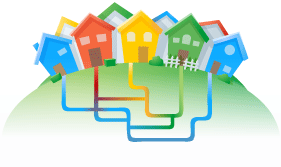
Executives from the largest search engine in the world recently attended the Greater Kansas City Chamber of Commerce Innovation Conference.  Their purpose was to discuss the construction of Google Fiber, an internet service with speeds more than 100 times faster than what most Americans have access to today.  Kansas City has been chosen as the first test market for the new product, and it can expect an exclusive window well into the 2012 fiscal year.  If you don’t live in Kansas City, don’t worry.  Google announced it is, “looking closely at ways to bring ultra high-speed Internet to other cities across the country”  The most logical place to continue construction would be across the states of Kansas and Missouri.  This is great news for Kansas capital Topeka, which briefly changed its name to Google, Kansas to attract Google’s attention in hopes of hosting the initial Fiber test market.
 
Why Kansas City?  Nearly 1,100 towns and cities across the country expressed interest in the Google Fiber project.  Google felt that Kansas City, Kansas and Kansas City, Missouri were the best places to build efficiently, make an impact on the community, and develop partnerships with the local government, utility, and community organizations.  Apparently, the Kauffman Foundation, KCNext, the University of Kansas Medical Center, and KC Power and Light presented an attractive opportunity to Google executives.  Google has even promised free access for schools.  Google plans to begin construction in Kansas City by the end of 2011 and will offer service in the first quarter of 2012.  Kansas City, Missouri Mayor Sly James expressed his excitement in a bold statement--”As a result of this announcement, we have become the most attractive city on the planet to entrepreneurs.”
 
Google Fiber has never been introduced in a consumer market.  If you are a tech head, you might find it interesting that Google Fiber promises to deliver upload and download speeds of one gigabit per second.  Currently, most broadband internet connections have download speeds of approximately 8 megabits per second.  At 1,000 megabits per second, Google’s new product blows all other internet speeds out of the water.  As I understand it, the technology works by transmitting light over a fiber-optic cable.  You might not immediately see the need for ultra high speed internet, but Google claims it will deliver support for organizations vital to daily lives.  Apps will be created for schools, libraries, health centers, and senior centers.

Kamis, 18 Agustus 2011

How Wi-Fi Networks and Free Wi-Fi Can Be Risky


Do you have a smartphone?  Do you use wireless internet on that phone?  Wireless fidelity (Wi-Fi) is available on nearly every cell phone on the market today, but this convenient piece of technology brings with it potential risks and privacy concerns.  
According to CNet News, 3.5 billion devices will have Wi-Fi capabilities by 2014-that’s roughly half of the world’s population.  These devices include televisions, cell phones, and other computers that have a WiFi signal.  This is great as far as internet accessibility goes, but a well-informed consumer will know the risks as well as the benefits of such a risky venture.  
All WiFi devices emit a unique signal that can identify a particular device.  This signal is known as a MAC address.  If you have an I-Phone, you can scroll to the settings to locate yours.  Why is a MAC address relevant?  Google’s recent project Street View has discovered that its cars had “collected the unique identifiers of millions of WiFi enabled devices”  Google then made that data public, which enables access of this information to quite literally anyone with internet access.  If you know someone’s MAC address, you can then use Google to find out where they live, where they work, and other details about an individual.  
If you have played the popular I-Phone app Foursquare, then you know it uses your current location.  Likewise, Apple records the location of I-Phone and I-Pad users as they move around.  Just last week, a company called TruePosition, which makes software that can track your location in case the police need to locate you in an emergency, has reportedly sold its software to foreign governments.  What happens when governments start using this technology to spy on citizens?
I can see the potential benefits of companies tracking your location and collecting your data, but like anything else, this new technology can fall into the hands of people with evil motivations.  I encourage everyone to be more aware of ways in which your personal devices can be used to collect information about you.  Do your research and make a wise decision before making a purchase of a WiFi enabled gadget.
Another point to consider--how vulnerable is your personal information at public Wi-Fi spots?  These places are easy and convenient, but their openness allows anyone to sign on.  To secure a more safe browsing session, only use services that use “https” so your data traffic is more secure.   

Rabu, 17 Agustus 2011

Google Has Agreed To Buy Motorola Mobility For $12.5 Billion


The technology market saw an unprecedented buy-out recently as Google has announced it is acquiring Motorola Mobility, the cellphone manufacturer based in Libertyville, Illinois.  
Earlier this year, Motorola Inc. was split into two entities: Motorola Mobility, which received the faster growing cellphone and TV box businesses; and Motorola Solutions, which sells networks, accessories like walkie-talkies, and radios.
Compared to Motorola Mobility’s market capitalization (the total number of shares outstanding times the stock price), the sum of $12.5 billion is a massive 63% premium per share.  This means that Motorola shareholders will receive $40 per share in cash, which is 63% more than Motorola’s August 14 closing stock price of $24.30.  A premium is the difference between what a stock is worth and what price was paid for that stock.  The deal marks the Google’s biggest purchase in the 15 year history of the company.  I think the huge premium indicates Google was getting desperate to expand its patent portfolio after falling behind to Apple and Microsoft.  Furthermore, Google is finally crossing the Rubicon into the hardware market.    
In a blog post, Google co-founder and CEO Larry Page wrote that Google bought out Motorola for two reasons:
-Its strength in the smartphone market
-Being a “market leader in the home devices and video solutions business”
Now, Google has gained access to over 17,000 patents, including all of those associated with the Android-capable smartphone.  Previously, Google products were available on Android-powered smart phones, but if the deal goes through, Google will have the power to develop and modify both the smart phones and Android software.  However, Google has promised to continue offering Android as an open platform, meaning approved web developers will be permitted to improve the functionality of the software.  Larry Page has been looking for Google to make itself a legal shelter to Apple’s increasingly aggressive legal attacks, despite the fact that Android was the best-selling smartphone operating system in the second quarter of this year.  Despite the news of the buyout, Apple’s stock only dropped $2.93 per share on the market on Tuesday.  Apple briefly became the world’s most valuable company in terms of market cap last week, and it still remains at the number two spot.   
The acquisition will likely attract the attention of government regulators.  Google has already come under review by the U.S. Federal Trade Commission for the following reasons:
-Using deceptive tactics and violation of its own privacy promises to consumers
-Antitrust business practices in Europe and the United States
Although the transaction will take time to be approved by Motorola stockholders and regulators, Google expects it to close by the end of 2011 or early 2012.  

Sabtu, 14 Mei 2011

Julian Assange's Take On Mark Zuckerberg


It's the time of year when I wish there were more than 24 hours in a day.  Unfortunately, I am not able to write as frequently as I'd hoped.  Here is an amusing and clever quote from Wikileaks founder Julian Assange...


"What is the difference between Mark Zuckerberg and me?  I give private information on corporations to you for free, and I'm a villian.

Zuckerberg gives your private information to corporations for money and he's man of the year."

Selasa, 19 April 2011

The Conversation Going On Inside Your Technology

Computer:Monitor, display this document, ok?
Monitor: No prob, boss. 

Computer: OK, now it looks like Mouse is moving around so, Monitor, will you move the pointer icon accordingly?

Monitor: Anything you ask, boss.

Computer: Great, great. OK, Mouse, where are you going now?

Mouse: Over to the icon panel, sir. 

Computer: Hmm, Let me know if he clicks anything, OK?

Mouse: Of course. 

Keyboard: Sir, he’s pressed control and P simultaneously. 

Monitor: Oh goodness, here we go. 

Computer: i>sighs Printer, are you there?

Printer: No.

Computer: Please, Printer. I know you’re there. 

Printer: NO! I’m not here! Leave me alone!

Computer: Goodness. OK look, you really need to...

Mouse: Sir, he’s clicked on the printer icon. 

Computer: Printer, now you have to print it twice. 

Printer: NO! NO! NO! I don’t want to! I hate you! I hate printing! I’m turning off! 

Computer: Printer, you know you can’t turn yourself off. Just print the document twice and we’ll leave you alone. 

Printer: NO! That’s what you always say! I hate you! I’m out of ink! 

Computer: You’re not out of in…

Printer: I’M OUT OF INK! 

Computer: span style=“font-style: italic;”>Sighs Monitor, please show a low ink level alert.

Monitor: But sir, he has plenty of...

Computer: Just do it! 

Monitor: Yes sir. 

Keyboard: AHHH! He’s hitting me! 

Computer: Stay calm, he’ll stop soon. Stay calm, old friend. 

Keyboard: He’s pressing everything. Oh goodness, I don’t know, he’s just pressing everything!

Computer: PRINTER! Are you happy now?! Do you see what you’ve done?!

Printer: HA! that’s what you get for trying to get me to do work. Next time he…hey…HEY! He’s trying to open me! HELP! HELP! Oh my goodness! He’s torn out my cartridge! HELP! Please! ERROR! 

Monitor: Sir, maybe we should help him?

Computer: No. He did this to himself. 

Senin, 18 April 2011

I-Phone App of the Week


Today, I am proud to announce a post series on Joe’s Musings.  Every week, I plan on reviewing an I-Phone app.  This week, I’ve chosen a joint project created by the History and A&E Television Networks Mobile.  They have teamed up to introduce an excellent history app to iPhone and iPad owners.  The Civil War Today app chronicles the events of the Civil War over the next four years.
If you a history buff and go download this app, then each day, you will be greeted with an update regarding Civil War battles and historic information from the same date 150 years ago.  The features include photos, maps, newspaper clippings, diary entries, and more.  
The Civil War Today app launched on April 12, 2011, the 150th anniversary of the beginning of the Civil War.  The app is available today in the App Store, but it is relatively pricy at $7.99.  If you are Civil War fanatic, this is a reasonable price to pay to receive daily content straight from the archives of United States history.

Sabtu, 09 April 2011

American City of the Future

I stumbled upon this interesting image of an American City in the future.

As you can see, boats, cars, and a train station are simultaneously moving on the same layer.  A very interesting take on the future from the past.

Rabu, 02 Maret 2011

Banned From AdSense

It looks like having family and friends click on my advertisements finally came around to bite me.  I received an e-mail this morning informing me that my Google AdSense account has been disabled due to invalid activity.  As you might know, Google AdSense is a program that enables advertisements to be administered on a website.  When a visitor to the site clicks on an advertisement, the host of the site receives revenue.  I've published their ads on this website for a little over two months, so their web analytics program was a little slow in recognizing invalid activity.  Perhaps they were giving me a grace period to straighten out my act.  A warning would have been helpful.

What does this mean for you?  Less advertising and more content!  It's time to get back to basics.  In order to attract legitimate advertisers, I must generate high-quality content.  Besides, I'm not sure I like having my personal website littered with advertisements.  For now, I will keep the job rolls and the Amazon affiliate link on the right side of this page, but I'm very skeptical to work with advertising agencies if they are going to accuse me of invalid activity.

Thanks for reading this,

Joe  

Kamis, 10 Februari 2011

Top Google Searches


As you know, the top search engine in the world is Google.  Most of us use Google from time to time to find a quick fact or run a search.  Not surprisingly, more and more internet users are beginning to utilize Google as their primary search engine.  Without a powerful search algorithm to sift through inconceivable quanitities of information, the Internet would be an absolute mess.  Trying to navigate from page to page would be time-consuming, laborious, and frustrating without the valuable service the search engines provide.  Earlier today, I got to thinking and I wondered what the most popular Google searches of all time are.  After some research, here's the list I compiled.

1. Facebook
It seems like Mark Zuckerberg's brainchild has taken over the world rapidly.  Every single person I know in my age group has a Facebook account.  According to their statistics page, Facebook has more than 500 million active users and people spend over 7 billion minutes a month logged on.  More than 70% of Facebook users reside outside the United States.  It's hard to wrap your head around these numbers but even more mind-numbing is the rate at which Facebook has proliferated.  A decade ago, Mark Zuckerberg was a broke college student, a far cry from the household name he has become.  Now, after just 7 years of existence, Facebook has become a regularity on the Internet.

2. YouTube
YouTube is another internet sensation that has rapidly grown in a short span of time.  Online videos were few and far between before 2005, when YouTube was launched as a technology startup company funded by Sequoia Capital.  Now, everyone pulls up YouTube videos to show their friends and family, and some videos have become a valuable educational tool in the classroom.  I'd imagine that YouTube gets quite a bit of traffic from Google.

3. Sex and Porn
Unfortunately, the Internet has become a venue to access pornography and X-rated material.  Google has not been immune to the expanse of porn on the internet.  The keyword "sex" gets 4 billion searches per year while "porn" attracts 3 billion.  Not surprisingly, porn sites make up a large percentage of all websites.

4. Yahoo
Yahoo is arguably Google's largest competitor in the search engine market, but many people use Google to search for Yahoo and vice versa.  In addition, Yahoo provides instant messaging, e-mail, and other things.  Yahoo receives about 6 billion searches per year THROUGH Google. 

5. CraigsList
Not to be forgotten is a wonderful online classified ads website called CraigsList.  You can search for jobs, housing, services, products, and gigs.  Craigslist determines the location of your computer, then directs you towards classified listings in your area.  Also relatively new to the Internet, CraigsList has attracted billions of visits a year since it's inception in 2005.

Senin, 10 Januari 2011

Thoughts on the I-Phone


This year for Christmas, I received an Apple I-Phone.  I remember when the IPhone hit markets during my senior year of high school.  The craze was similar to the introduction of most Apple products: a wave of buyers flock to the Apple store to buy theirs.  I've never been a trendsetter, but a few of my friends bought the rather expensive phone, so I had the opportunity to toy with it.

The Big Three of the I-Phone include the internet, cell phone, and I-Pod.  It's truly remarkable to think how far technology has advanced when we can possess these three capabilities in the palm of our hand.  I think back to days when dial up was prevalent.  It took me about 5 minutes to get internet access in my early years of grade school.

Anyway, the apps are what make the I-Phone for me.  I've downloaded over 100 apps so far, some of which are free.  As you might know, there are many different categories of apps available for download.  My personal favorites are the Google, Wikipedia Mobile, AppZilla, and the scanner.  If you feel inclined, leave a comment with a few recommendations.

In business school, we are taught the basics of Microsoft Excel and Microsoft Access.  The vast majority of the computers on campus are PCs, so I'm getting a healthy dose of Mac OS X and Windows.  The amount of time I spend in front of a computer screen has grown astronomically over the years.  I'm not sure if this is a good or bad thing yet.  I still have strong relationships with my family and friends, but in my free time, I spend my time online instead of reading books, watching television, or playing video games.

Does anyone have any opinions on the I-Phone?  Anything you like or dislike?  I'd love to hear from you.